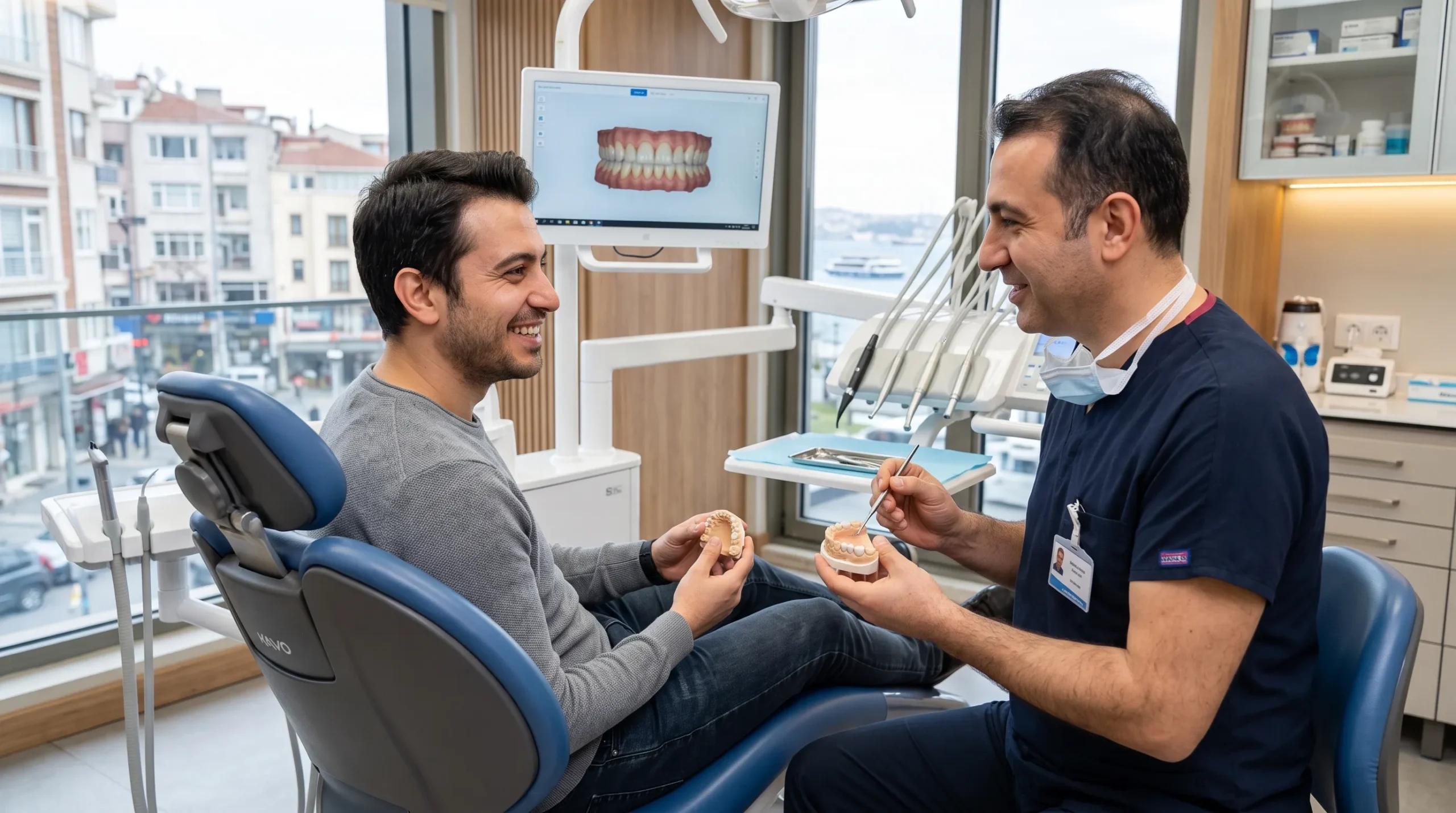
Explore smile-focused dental options in Istanbul. Compare Hollywood Smile planning, dental veneers, E-max ceramics, professional whitening and composite bonding. The right approach depends on tooth health, bite, preparation requirements and personal goals.
Understand options for repairing damaged teeth and replacing missing teeth in Istanbul. Compare zirconia crowns, dental bridges and appropriate alternatives based on tooth structure, bite, supporting tissues and maintenance needs.
Two different restorations for different starting points
Imagine two neighbouring front teeth. One is intact but its shape bothers you. The other already has a large filling. You may want them to match when you smile, yet the dentist might propose different work for each. Ask to see the reason for each recommendation on your own records.
Start with the tooth you already have
The choice involves two decisions: how much of the tooth to cover and which material to use. Ask the dentist to explain the coverage first. Then discuss how the proposed ceramic would look beside your other teeth.
Discussing an E-max veneer
A veneer covers the front surface of a tooth. Ask what preparation the plan requires and which features of the existing tooth would influence the result. Our E-max veneers guide explains the questions to ask about the ceramic named in your quote.
Discussing a zirconia crown
A crown covers the prepared tooth. If a crown is proposed, ask to see which part of the tooth needs that coverage, whether a smaller restoration is an option and how the bite will be checked. See the zirconia crown guide for the fitting process.
Veneer and crown comparison
Use the comparison as a list of questions for an examination. Bring any previous treatment records for the teeth concerned.
Decision
E-max veneer
Zirconia crown
Coverage
Front surface of the tooth
Around the prepared tooth
Reason to discuss it
Ask what change the front surface needs
Ask why fuller coverage is proposed
Existing dental work
Discuss enamel and previous fillings
Discuss remaining tooth and previous restorations
Appearance
Review shade and visibility of underlying colour
Review shade and fit beside neighbouring teeth
Preparation
Ask how much enamel would be removed
Ask which surfaces would be shaped
Future care
Ask about repair or replacement
Ask about review, adjustment or replacement
For the wider range of options, see dental veneers and composite bonding. Ask what would happen if you left a tooth as it is.
When a plan includes both veneers and crowns
If the proposal combines different restorations, ask for a diagram naming every tooth, the reason for the choice and how the dentist will check the teeth next to one another. Agree when you can review the shape and shade.
Questions to Ask Before You Commit
Which tooth needs coverage, and what finding led to that recommendation?
Which ceramic and manufacturer will be named on the treatment record?
When can I review the proposed shape and shade beside my own teeth?
How much tooth preparation is planned, and what other options are available?
When you request an appointment, mention any existing crowns or fillings as well as the change you want. Ask which questions can be answered now and which require an examination.
Questions about veneers and crowns
Which is better for a Hollywood Smile, E-Max veneers or zirconia crowns?
The starting tooth, your priorities and the alternatives determine the discussion. Ask your dentist to explain the recommendation tooth by tooth before considering material names or package prices.
Do zirconia crowns look as natural as E-Max veneers?
Ask to see shade samples beside your own teeth. Check what can be reviewed before fitting and how a change would be handled if an adjacent tooth looks different.
Will my dentist decide the material for me?
Your dentist can explain the options and their trade-offs. You can ask for a written plan, an alternative and time to consider them before agreeing to preparation.
Does mixing materials in one smile look inconsistent?
If different restorations will sit side by side, ask how the laboratory will match them and when you can see them together. Discuss the shade and shape in the lighting you use for the review.
Which option costs more in Istanbul?
Request a price for each tooth, including any temporary and laboratory fees. Compare the same number and type of restorations and ask how future adjustments or replacement would be charged.
Zirconium Crowns: Benefits, Process & Cost
Looking for a crown material that combines strength with a natural look? Zirconium crowns have become one of the most trusted options in modern restorative dentistry. Read our complete guide to how they’re made, their benefits, and what to expect from treatment below.
What Are Zirconium Crowns?
Zirconium crowns are dental restorations milled from zirconium dioxide, a ceramic material prized in dentistry for combining exceptional strength with a tooth-like appearance. A biomaterials review published in Frontiers in Dental Medicine notes that zirconia’s high bending strength and corrosion resistance, paired with its chemically inert nature, make it especially well tolerated by surrounding tissue compared with traditional metal-based crowns.1 This combination is why zirconium crowns have largely replaced metal and porcelain-fused-to-metal crowns in many modern practices.
Benefits of Zirconium Crowns
Exceptional Durability: Zirconia withstands heavy biting forces, making it a preferred choice for molars and patients with bruxism (teeth grinding).
Biocompatibility: Because zirconia contains no metal, it carries virtually no risk of allergic reaction and is well suited to patients with metal sensitivities.
Natural Appearance: Modern high-translucency zirconia mimics the light-reflecting quality of natural enamel far more closely than older ceramic-metal crowns.
Stain Resistance: The dense, non-porous surface resists discoloration from coffee, tea, and tobacco far better than composite materials.
Long-Term Reliability: A 15-year prospective study published in BDJ Open followed hundreds of zirconia-based crowns and concluded that zirconia restorations remain a dependable long-term solution for both tooth-supported and implant-supported crowns.2
The Zirconium Crown Process, Step by Step
1. Tooth Preparation: The tooth is gently reshaped to make room for the crown, requiring less removal of healthy tooth structure than older crown types.
2. Digital Scan: A 3D intraoral scan captures the precise shape and bite alignment, replacing the need for uncomfortable physical impressions.
3. CAD/CAM Milling: The crown is designed on computer and milled from a solid block of zirconia, often the same day in clinics with an on-site laboratory.
4. Fitting & Bonding: Once the shade, shape, and bite are confirmed, the crown is permanently bonded in place.
Zirconium Crowns vs. Other Restoration Options
Compared to porcelain-fused-to-metal crowns, zirconium crowns avoid the dark metal line that can appear at the gumline over time, and they don’t carry the same allergy risk. Compared to E-Max veneers, zirconia trades a small amount of translucency for significantly higher fracture resistance, making it the preferred choice for back teeth and heavy bite forces. For a full side-by-side breakdown, read our comparison of zirconium crowns vs. veneers, and our guide to E-Max Veneers or Zirconia Crowns.
How Much Do Zirconium Crowns Cost?
Treatment
Average Price in Turkey
Average Price in US/UK/Europe
Single Zirconium Crown
$180 – $350
$800 – $1,500
Full Zirconium Crowns Package (20 teeth)
$3,000 – $4,500
$12,000 – $18,000
To review comprehensive cost factors, check our analysis of the Hollywood Smile Turkey package, and compare price guide parameters in our report on the Hollywood Smile in Istanbul cost, since full-mouth zirconium crowns are one of the two core material options in a smile makeover.
Who Is a Good Candidate for Zirconium Crowns?
Zirconium crowns are well suited to patients needing a durable restoration on molars or premolars, those with bruxism, patients with metal allergies, and anyone undergoing a full-mouth restoration who wants a uniform, long-lasting result. They’re also commonly used to cap dental implants as part of full arch dental implants in Turkey.
Caring for Your Zirconium Crowns
Zirconia requires no special maintenance beyond standard oral hygiene—regular brushing, flossing, and routine dental check-ups. Avoid using your crowned teeth to open packaging or bite excessively hard objects, and your zirconium crown should perform reliably for many years.
FAQ: Frequently Asked Questions About Zirconium Crowns
How long do zirconium crowns last?
With good oral hygiene, zirconium crowns commonly last 15 years or longer, with long-term clinical studies reporting reliable performance well beyond a decade of use.
Are zirconium crowns better than porcelain?
It depends on the location in the mouth. Zirconium crowns generally offer superior fracture resistance for back teeth, while traditional porcelain or E-Max can offer marginally more translucency for front teeth where light transmission matters most.
Is the crown fitting process painful?
No. Tooth preparation is performed under local anesthesia, and most patients report only mild sensitivity for a day or two afterward. All clinical services utilize comfort protocols, offering certified pain-free dental procedures.